R&D Team
Hardware, firmware and APP engineers driving new platform development.

A baby monitor manufacturer with in-house engineering and our own production lines.
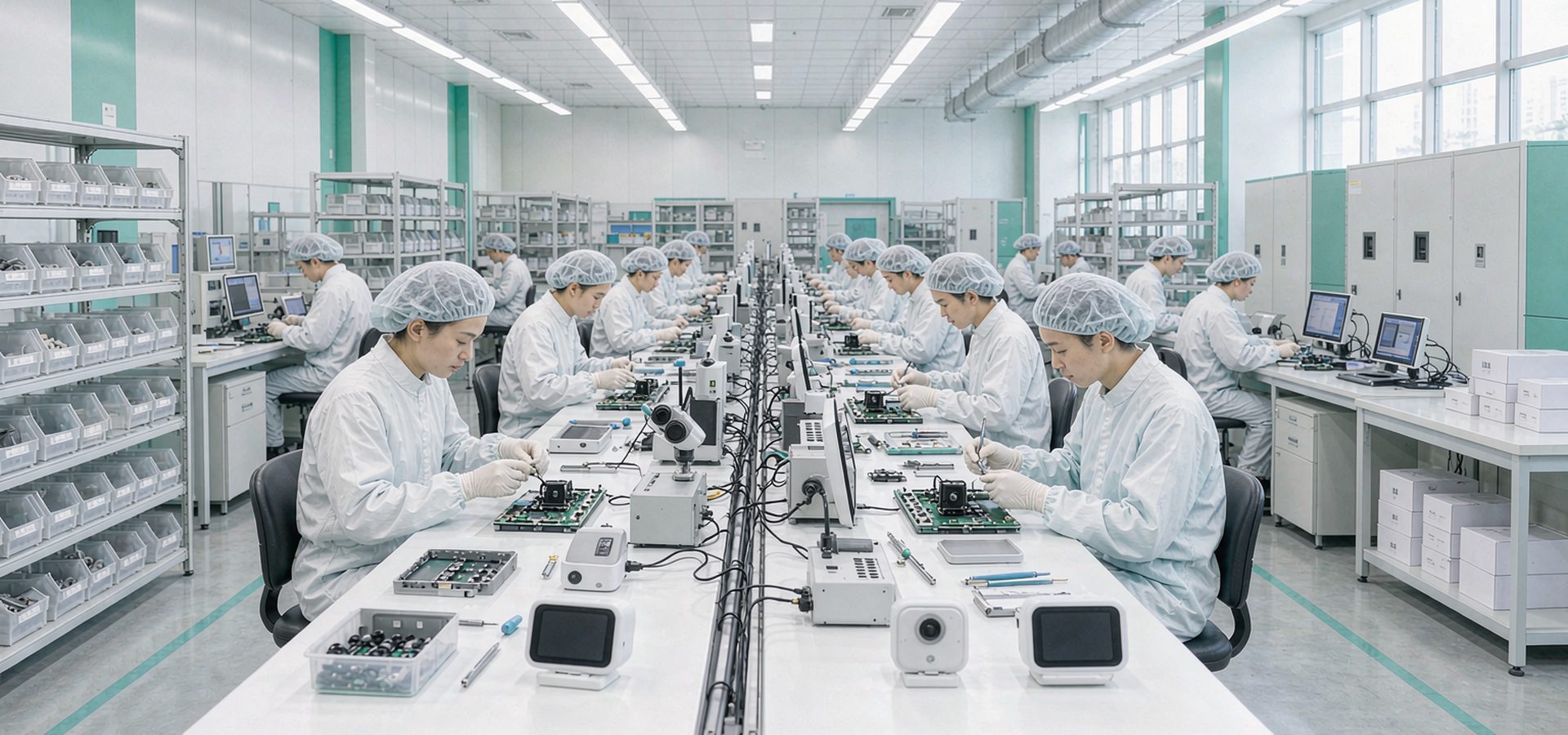
Shenzhen Dayun Links Co., Ltd. is a baby monitor manufacturer based in Baolong Sci-Tech City, a national-level high-tech zone in Shenzhen. Founded in 2016, the company focuses on a single product category — baby monitors — with 10 years of manufacturing experience and a founding team carrying 20+ years of audio & video supply-chain expertise.
Every core step is handled in-house: circuit board design, ID and structural design, firmware, tooling and mass production. All components are sourced and inspected by our own team, and 100% of units pass functional testing before shipment. Near 100 employees work on 3 dedicated lines — two 35-meter assembly lines (one for monitors, one for cameras) plus a separate packaging line — delivering a monthly capacity of 60,000 PCS.
More than 90% of our output is exported to the US and European markets. We work with Amazon top sellers and cross-border platforms including TEMU, AliExpress, SHEIN and TikTok Shop, and have delivered large-volume programs for brands such as VAVA, MOMCOZY, BABYSENSE, GHB and GOODBABY. Whether you need OEM production from 500 PCS or a full private-mold program, we support you from sample to shipment.
Our engineering team turns concepts into certified products: industrial design, RF / wireless tuning, low-power video pipeline and mobile-app integration are all run under one roof, shortening the path from prototype to mass production.
We support the full engagement model — private-mold ODM for brands that want a unique product, and flexible OEM for established SKUs — with transparent documentation, clear tooling ownership and responsive project management from kickoff to after-sales.
| Factory Area | 5,000 m²+ |
|---|---|
| Employees | 100+ |
| Production Lines | 3 (2 Assembly + 1 Packaging) |
| Monthly Capacity | 60,000 PCS |
| Founded | 2016 |
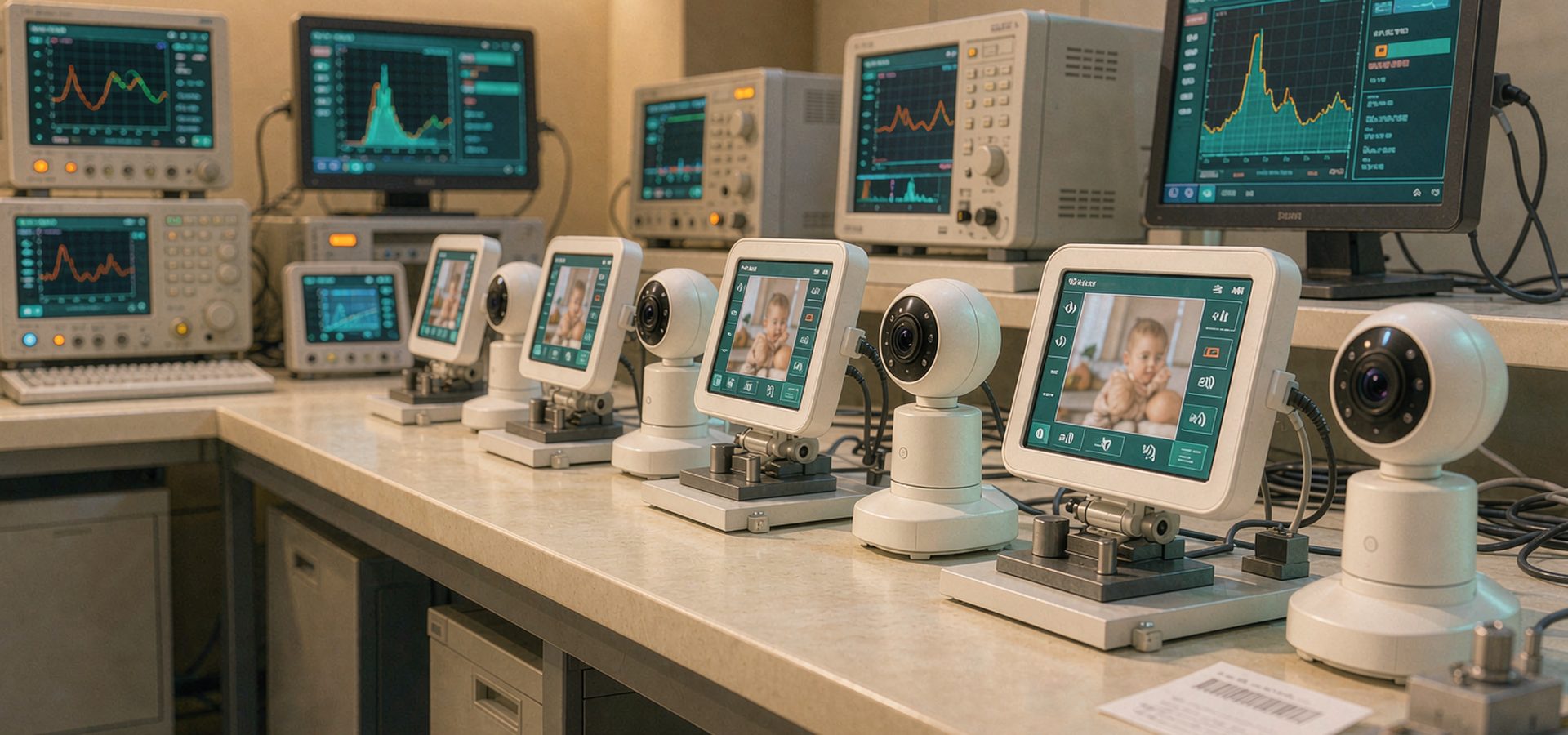
| Reliability Lab | 5 wireless shielded rooms, 2000-unit aging rack, -40~80°C chamber, TYPE-C insertion & drop tests |
Founded in Shenzhen Baolong Sci-Tech City, a national-level high-tech zone. Team brings 20+ years of audio & video supply-chain experience.
Launched one of the industry's first 720P / 1080P baby monitors when the market was still dominated by low-resolution small screens.
HD models gained strong traction as demand surged, establishing Dayun as a core baby monitor factory.
Long-term OEM and private-mold programs with leading Amazon sellers and global brands.
Hardware, firmware and APP engineers driving new platform development.
Industrial design and mechanical engineering from sketch to tooling.
IQC, IPQC and OQC coverage, plus 100% functional testing.
Project managers who handle quotes, sampling and shipment follow-up.
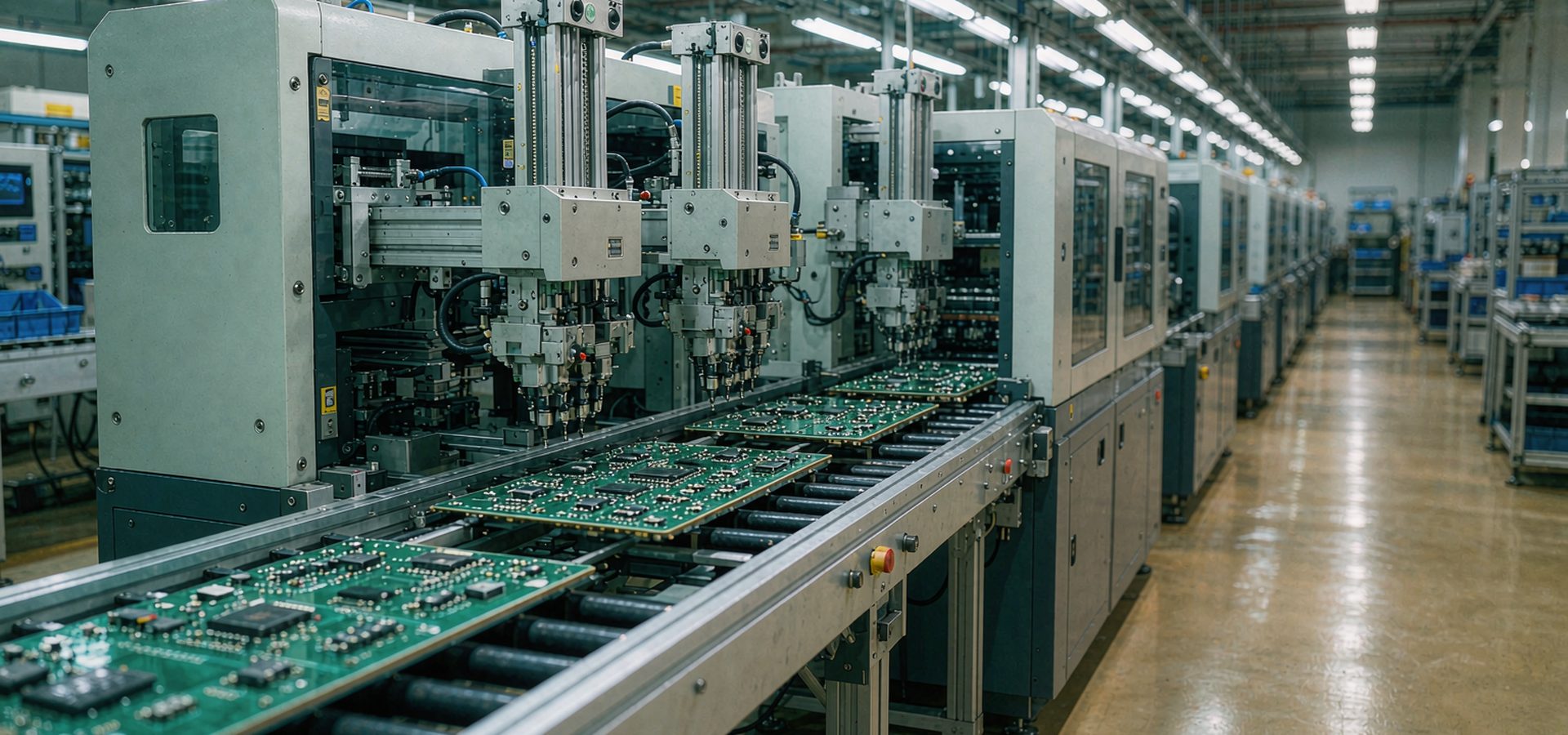
We are a factory. Shenzhen Dayun Links Co., Ltd. is a baby monitor manufacturer based in Baolong Sci-Tech City, a national-level high-tech zone in Shenzhen. Every core step happens in-house: circuit board design, ID and structural design, firmware, app development, tooling and mass production. Components are sourced and inspected by our own team rather than resold from a third party, so the person you speak with is the person who controls the production floor. More than 90% of our output is exported to the US and European markets. If you visit, you will find our own SMT lines, assembly lines, reliability laboratory and packaging line on site — there is no factory behind us.
The company was founded in 2016 in Shenzhen Baolong Sci-Tech City, which gives us 10 years of manufacturing experience in a single product category. The founding team brought 20+ years of audio and video supply-chain expertise with it. We shipped one of the industry's first 720P and 1080P baby monitors in 2018, when the market was still dominated by low-resolution small screens. 2020 was our breakthrough year, when HD models gained strong traction and established us as a core baby monitor factory. Since 2023 we have run long-term OEM and private-mold programs with leading Amazon sellers and global brands. Specialising in one category for this long is why our process is repeatable rather than improvised per order.
Our factory covers 5,000 m² of floor space with 100 employees, running 3 dedicated production lines: two 35-meter assembly lines, one for monitors and one for cameras, plus a separate packaging line. The scale is deliberately matched to one product category. A single-category factory of this size can keep every project on the same production system, which means your second order repeats the first order's settings instead of starting over. We are based in Baolong Sci-Tech City, Shenzhen, which concentrates electronics manufacturing, tooling vendors and component supply within a short drive of the factory.
Yes. 3,000 m² of our production floor is a dedicated dust-free workshop, used for the assembly stages where a single speck of contamination would show up on a screen, a lens or an acoustic grille. Dust control matters more here than in most electronics because a baby monitor is a device people hold next to a sleeping child and look at in low light for hours. The remaining production space covers SMT, testing and packaging. We keep the dust-free boundary physically enforced rather than relying on housekeeping discipline alone, and the packaging line is kept separate from the assembly floor so that finished cartons are never exposed to the same airborne dust as open hardware.
Monthly capacity is 60,000 PCS, delivered across 3 dedicated lines and 100 staff. We plan capacity against a rolling schedule rather than a single theoretical peak, so a large order is slotted into a real production window and you get a firm date instead of an optimistic one. Capacity is also the reason we quote a minimum order quantity at all: below that level the setup cost per unit exceeds what the unit is worth, and we would rather tell you that up front than quote a price that cannot be built profitably. If your forecast grows fast, tell us early and we will show you where the bottleneck sits before you commit to a delivery date.
We manufacture five categories of baby monitor and sleep audio products: WiFi cameras, video monitors, audio monitors, battery cameras and white noise machines. The video range covers 5-inch and 5.5-inch HD displays, with 720P and 1080P models available, including handheld units with a 360-degree pan-tilt camera. WiFi models run on the Tuya Smart app and support dual WiFi and Bluetooth connection so the unit still works locally when the cloud link drops. Audio-only and battery camera lines cover the simpler use cases. White noise machines round out the range for sleep-sound programs. Because all five run on shared firmware and tooling platforms, you can build a coherent product line from one supplier instead of five.
Almost everything that defines the product in the customer's hands: industrial design, housing and structure, circuit board, firmware, the app, colour, logo placement and the complete packaging. Our ID, structural, firmware and app teams all sit in the same building, so a change to one does not wait on another. In practice most customers start with a standard platform and then customise the industrial design, logo and packaging, because that gets them to market fastest while keeping the electronics risk low. A fully custom ID from a sketch you provide is also possible, but it extends the schedule and we will always quote the full timeline before you commit.
OEM means you already have a design and specification, and we manufacture to it with your logo, colour and packaging — the minimum order is 500 PCS. ODM means you want to launch quickly without owning a design: we supply the industrial design, electronics and firmware, and you take it to market as yours. Private mold goes further still, with independent tooling for the housing and structure, so the product's appearance belongs exclusively to you; the minimum order is 1,000 PCS. The practical difference is ownership and cost: OEM is fastest and cheapest, ODM buys you a finished concept, and private mold buys you exclusivity. We will recommend the one that matches your channel and volume rather than the most expensive route.
Yes, that is what the ODM team does every day. Hardware, firmware and app engineers drive new platform development, and a separate structural team handles industrial design and mechanical engineering from sketch to tooling. A typical path runs from requirements and a reference product, through a feasibility and cost review, into a prototype for your approval of appearance, function and packaging, then tooling, then production and QC. Because tooling is done in-house, the transition from sample to mass production does not involve a third-party queue. We have shipped new models from this process for brands entering the category for the first time, and we will tell you honestly when a requirement is technically risky rather than discovering it at prototype stage.
Yes. The WiFi and video ranges are built on the Tuya Smart platform, which means the app layer, cloud services and device onboarding are already proven at scale rather than something we wrote from scratch. Our dual-mode design supports both WiFi for long-distance remote monitoring and Bluetooth for quick nearby access, so the parent unit still functions locally when the internet is down. Typical features include 720P and 1080P video, 360-degree pan-tilt control, HD night vision, two-way talk, AI motion and sound alerts, crying detection and local recording to SD card, with multi-user safe sharing for family members. For your own brand, the app can be re-skinned with your logo, colours and onboarding flow.
Our main handheld screen sizes are 5-inch and 5.5-inch HD displays, which is the range most buyers settle on: large enough to check a sleeping baby clearly at night, small enough to sit on a bedside table without dominating the room. We offer 720P as the volume platform and 1080P where the target market expects a higher specification. The camera side supports HD night vision and, on the premium models, a 360-degree pan-tilt unit so you can follow movement across the room. Display and camera specifications are decided at the platform level rather than per unit, which is what keeps tooling costs and unit pricing predictable across a product line.
The platform supports the functions buyers actually ask for: two-way talk for parents and grandparents, VOX voice-activated operation so the unit stays quiet until the room needs attention, cry detection that classifies crying separately from ordinary sound, temperature monitoring, night vision for dark rooms, and local SD recording so footage stays on the device. Premium WiFi models add 360-degree pan-tilt control and app-based remote viewing. Functions are selected at the platform level and carried into your firmware build, so you are not paying for engineering work that a customer segment will never use. We also flag honestly when a feature raises certification scope, because a radio change can affect the CE, FCC, RoHS, CPC and PSE file you are targeting.
Yes. White noise machines are part of our sleep-audio range, built on the same audio engineering and acoustic tuning capability as the monitor speaker path. That shared foundation matters for you commercially: a retailer who sells both a monitor and a sleep sound device gets consistent industrial design, consistent packaging and a single supply relationship. We customise the housing, control interface, sound library and packaging for private label programs in the same way as the monitors. If you are building a sleep category rather than a surveillance category, tell us your target retail price and we will tell you honestly whether the acoustic specification you have in mind can be met at that cost.
We run an ISO9001 quality management system across design, procurement and production, and an ISO14001 environmental management system with RoHS-compliant material control. For market entry we support CE and RoHS for the European Union, FCC and CPC for the United States, and PSE for Japan, plus IEC62368-1 product safety testing. The right set for a given order depends on where the product will be sold and sold into, so we scope certification into the quotation rather than quoting a product and revealing the compliance cost later. The certificate scan and validity period are shared on request, and we confirm current status with each quotation.
Yes — ISO9001 for the quality management system covering design, procurement and production, and ISO14001 for environmental management, which in practice means controlled material sourcing and RoHS compliance handling. Both are system certifications rather than product certifications, and they matter to you because they describe how the factory behaves between orders, not just how one unit was tested. Document-controlled engineering change orders are linked to customer feedback, so when you request a modification it becomes a tracked change with a revision, not a verbal instruction. The certificate scan and validity period are available on request, and we re-confirm current status at every quotation rather than sending a file that may have lapsed.
It runs in three stages. Incoming inspection covers key components at 100% and general parts by random sampling. In-process inspection covers first-piece confirmation, patrol inspection and SPC on critical stations, so a drifting process is caught on the line rather than at the packing table. Final QC combines OQC with a 100% functional test on every single unit — audio, video, RF range, battery and charging, not a sample. We also maintain a reliability laboratory with wireless shielded rooms, an aging rack for burn-in before packing, temperature chamber cycling, key-press and connector life testing, and drop, vibration and packaging transport tests. Third-party inspection is welcome at any stage, and we have the records to support it.
Every unit goes through a 100% functional test before it is packed — audio, video, RF range, battery and charging. That is on top of incoming and in-process inspection, so a product that reaches packing has already passed inspection at three different points. The reliability laboratory adds the slower tests that cannot be compressed into a production cycle: burn-in aging on a 2000-unit rack, temperature chamber cycling, key-press and connector life testing, and drop, vibration and packaging transport testing. This matters because the most common baby monitor failures are not assembly defects but fatigue ones, and fatigue only shows up under repeated use. Our testing is aimed at the failures your customers would actually report in month three, not month one.
The minimum for a standard OEM program with your logo and packaging is 500 PCS. That is the level where setup cost per unit still makes commercial sense on our lines, and we would rather quote it honestly than win an order with a price that cannot be built. A private mold program carries a higher minimum of 1,000 PCS, because the tooling investment has to be amortised across the run. Sampling is supported separately from both, so you can evaluate the product before committing to a production quantity. If your planned launch quantity is below these thresholds, tell us and we will look at whether a shared platform with your branding would serve you better than a full custom program.
Sampling takes 7 days, and yes, we support it. The sample fee is negotiable and refundable against a mass order, so evaluating the product does not carry a sunk cost if you go ahead. A sample build is used to approve three things together: appearance, function and packaging. That third item is where most surprises happen, so we prefer to show you the packed retail box rather than a bare unit on a workbench. Sampling runs on the same platforms as mass production, which means the unit you approve is representative of what you receive at volume. If your schedule is tight, tell us your required ship date when you enquire and we will confirm whether it is realistic before you spend time on it.
Standard OEM production runs 35 days from order confirmation, and a private mold program also runs 35 days once tooling is in place. That lead time covers SMT, assembly, in-process inspection, final QC and functional testing — it is a production date, not a shipping date, so transit has to be added on top. We quote it this way because the number that matters to you is the date the goods land, and hiding freight inside a production lead time makes both numbers look better than they are. For large accounts we can discuss a rolling schedule with staggered deliveries, and we are happy to lock the production window early in the relationship once the specification is stable.
Seven steps. Inquiry: you submit requirements, target quantity and target markets, and we reply within 24 business hours. Solution and quote: we evaluate the concept and quote with MOQ, lead time and certification scope included. Sampling: a prototype build for your approval of appearance, function and packaging. Order confirmation: proforma invoice signed, deposit paid, production schedule locked. Production: SMT, assembly and in-process inspection under ISO9001 control. QC and inspection: 100% functional testing plus final QC, with third-party inspection welcome. Shipping and after-sales: export packing, shipment booking and warranty support after delivery. You get a named project manager across all seven.
Yes, and we recommend it. Sampling is a standard step in our process rather than a special favour, with a 7 days turnaround. The sample fee is negotiable and refundable against a mass order. We would rather you spend 7 days finding out about an issue at sample stage than discover it in a container that has already been shipped. What the sample should resolve for you is appearance, function and packaging together, since a monitor that works perfectly but arrives in an unacceptable retail box is still a problem. Once the sample is approved, the specification is frozen, which is what allows us to lock a production date and honour it.
The normal structure for a first order is a deposit with the balance against the copy of the bill of lading, and we also work with documentary L/C at sight for larger or first-time accounts. We would rather be flexible on the mechanism than be vague, so the actual arrangement is agreed in writing on the proforma invoice before anything starts, and it is the same structure we use with existing customers rather than something negotiated per order. If your company requires a specific form of payment, raise it at enquiry stage and we will tell you straight away whether it is workable. We also prefer to discuss this before the order is placed rather than after the goods are ready to ship.
We regularly quote on EXW, FOB and CIF terms from Shenzhen, and we are open to other arrangements where the destination and the volume justify it. On shipping method, air freight or express courier suits samples, replenishment orders and launch quantities; sea freight is the sensible choice for volume programs, and we will give you the container plan so you can budget for it. We handle export packing and shipment booking, and we can work with your nominated forwarder if you prefer to keep control of freight in your own name. Tell us your destination port or airport and your required delivery window when you enquire, and the quotation will carry the freight terms in it rather than as a later surprise.
Every order is covered by warranty support after delivery, and we respond to enquiries within 24 hours on business days — our working hours are Monday to Saturday, 09:00 to 18:30 GMT+8. After-sales is handled by the same project manager who ran your order, because they hold the build record and the failure history, which makes root-cause analysis possible instead of guesswork. We handle warranty claims by reference to the incoming unit's failure mode, and where a defect is confirmed the remedy is agreed case by case. We would rather explain this at order stage than after something has gone wrong, so if you need specific warranty terms written into the contract, ask and we will put them there.
Packaging is part of the customisation scope, not an afterthought. Each unit goes into its retail colour box, and the boxes are packed into export cartons prepared for sea or air transit depending on your shipping method. We also run a dedicated packaging line as one of our 3 production lines, so packing is a controlled process with its own staffing rather than something done at the end of the line when the floor is busy. For private label programs we produce the artwork, the print and the carton structure to your specification, and the packaging is approved at sample stage together with the product, so what you sign off is what ships. If your retail channel has specific labelling or barcode requirements, raise them before sampling.
Samples ship by express or air freight, which is what makes them useful for launch planning: a sample that takes two weeks to arrive has already cost you a selling season. Because the sample fee is refundable against a mass order, sending several units to different reviewers or to a retail partner carries no commitment. For early production we can arrange split shipments, sending part of the quantity to meet a launch window and the balance by sea to control freight cost. We will plan this with you rather than ship everything at once by air, which is usually more expensive than buyers expect. Tell us your launch date and your channel plan and we will propose a delivery schedule against it.
A trading company sells you a product; we manufacture it. Because circuit board design, industrial design, structure, firmware, the app, tooling and production are all in-house at one site, a specification change costs us a production adjustment rather than a supplier negotiation, and a tooling question is answered by the people who own the tooling. You also get the full benefit of the scale we have built — 3 lines, 60,000 PCS monthly capacity and 10 years in one product category — instead of the subset a trading company chose to stock. We supply for established brands including VAVA, MOMCOZY, BABYSENSE, GHB and GOODBABY, and work with Amazon top sellers and cross-border platforms including TEMU, AliExpress, SHEIN and TikTok Shop. The practical test is simple: ask to visit the factory.
We do not ask you to trust us on paper. Start with a sample: 7 days to build, a fee that is refundable against a mass order, and an approval covering appearance, function and packaging before you commit to a production quantity. Second, the quote is complete — MOQ, lead time and certification scope are all inside it, so there are no later additions to the cost. Third, the production date is locked after deposit, and a named project manager follows the order through QC to shipment. Fourth, third-party inspection is welcome at any stage, and our QC records support it. We are aware that switching supplier carries a cost for your business, so the point of all this is to make the trial cheap and the evidence available rather than to ask for confidence up front.
We reply within 24 business hours, and your working hours are Monday to Saturday, 09:00 to 18:30 GMT+8. You will be dealing with a project manager rather than a shared inbox — the sales team is structured so that one person owns the quotation, the sampling and the shipment follow-up for your programme. That person also holds the build record and any failure history, which is what makes after-sales diagnosis possible. For an account of your volume we will also put a direct factory contact in place for technical questions that need to reach the line. Reach us by email, phone, WhatsApp or WeChat; the quickest route for a technical brief is email with your target quantity and target markets, so we can quote completely on the first reply.